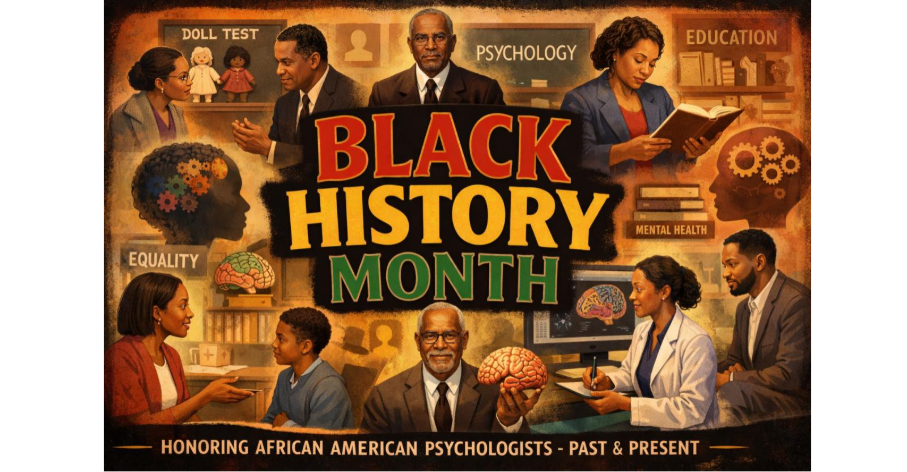
The following is the Presidential Message by PSCP’s then-President Christina Gallman Kemp, Psy.D. that was published online in the PSCP Newsletter on February 6, 2024. We are republishing it here, with Dr. Kemp’s permission, to acknowledge the continued importance of learning about and appreciating the contributions of Black Americans in many fields, including psychology.
African American Psychologists Contributions to Psychology
Christina Gallman Kemp, Psy.D.
As we begin the month of February and the celebration of Black History Month, let us remember the many contributions Black or African American people have made to the fields of science, education, medicine, sports, and the arts to name a few. Of particular importance to PSCP are the significant contributions African Americans have made to the field of psychology some of which are highlighted below. You are encouraged to research and celebrate the many others including psychiatrists like Dr. Solomon Carter and Dr. Warren E. Smith.
Kenneth Clark’s work was essential in the case of Brown v. Board of Education and the famous “Doll Study” which illustrated that children showed preference for white dolls from as early as three years old. He concluded segregation was psychologically damaging which played a role in the Supreme Court decision in outlawing segregation. He was the first black president of the American Psychological Association.
Mamie Clark showed that African American children became aware of their racial identity at about three years old and began to internalize societal views about them. She also found that many African American children were tested and incorrectly diagnosed with a learning disability or disabled due to biased psychological testing.
Francis Cecil Sumner was the first African American to receive his Ph.D. in Psychology. He helped establish the psychology department at Howard University and completed research which counteracted racism and bias in psychological studies of African Americans.
Robert Lee Williams II created the Black Intelligence Test of Cultural Homogeneity and showed that African Americans weren’t intellectually inferior to European Americans, but the differences in speech and experience could skew IQ results.
Jospeh L. White helped found the Association of Black Psychologists and has been referred to as the “Father of Black Psychology”. He wrote, “Toward a Black Psychology,” which is credited as being the first-ever strengths-based (rather than deficit-based) evaluation and description of Black behavior and culture. He pointed out the many problems which can arise (such as misdiagnosis and overpathologizing) when traditional Western Psychology is applied to African Americans without the use of a cultural lens and appreciation of the history of Blacks.
Kobi Kambon (AKA Joseph A. Baldwin) served as the president of the Association of Black Psychologists from 1982-1983. He does research in the areas of African American mental health and psychological outcomes of racial-cultural oppression of African Americans the U.S.
Beverly Daniel Tatum is a race relations expert whose research includes racial identity development and the role of race in the classroom. Her book, “Why Are All the Black Kids Sitting
Together in the Cafeteria?” examines the development of racial identity which she argues is essential to the development of children.
William E. Cross began his career as a “social experimental psychologist” at Cornell, and his work examined the cultural, historical, and economic forces shaping human development and everyday psychological functioning in general, and black identity development and functioning in particular. He developed the understanding of Black identity through a five-stage theory of acquiring Black identification: theory of Nigrescence,”the process of becoming Black.”
Harriette Pipes McAdoo worked with her husband on the Family Life Project, a study of Black middle-class families in the Washington, DC area. Her work challenged the widely-held, harmful racial stereotypes held about Black families.
Beverly Greene, author of “When the Therapist is White and the Patient is Black: Considerations for Psychotherapy in the Feminist Heterosexual and Lesbian Communities” is a pioneer of intersectional psychology. Her work has illuminated how different intersecting facets of a person’s identity shape their experiences of privilege, oppression, and mental health.
Arthur Evans, Jr., is the Chief Executive Officer and Executive Vice President of the American Psychological Association. Evans spent 12 years as commissioner of Philadelphia’s Department of Behavioral Health and Intellectual disAbility Services and led the transformation of the agency’s approach to serving a wide range of individuals with complex needs.